Archive Item
West Parish meeting house ROOTS HAYNES
Accession Number
RFLA.SWAN.DOC.2026.04968
Item Name
West Parish meeting house ROOTS HAYNES
OCR Text
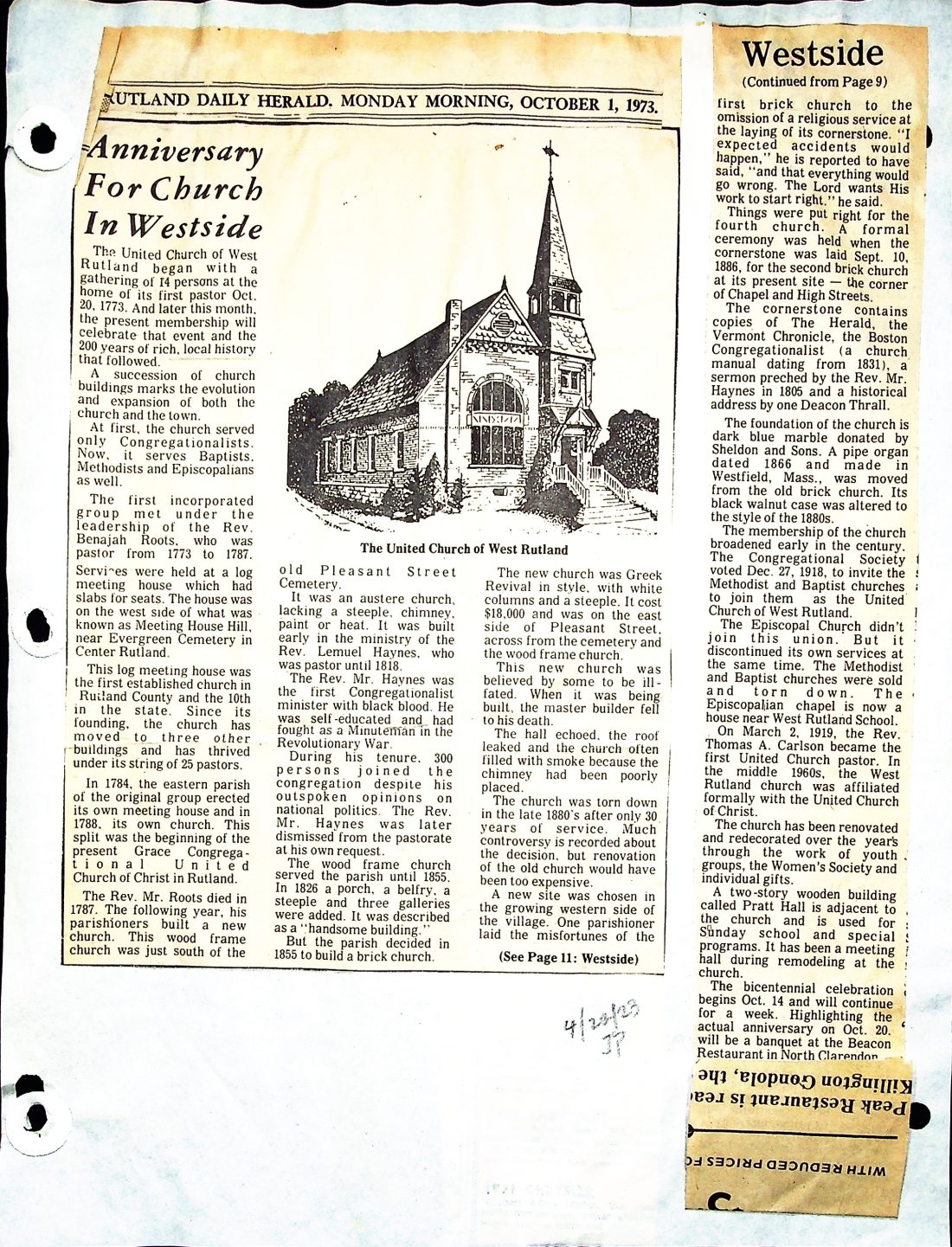
{"page_1": " # Anniversary For Church In Westside\n\nThe United Church of West Rutland began with a gathering of 14 persons at the home of its first pastor Oct. 20, 1773. And later this month, the present membership will celebrate that event and the 200 years of rich, local history that followed.\n\nA succession of church buildings marks the evolution and expansion of both the church and the town.\n\nAt first, the church served only Congregationalists. Now, it serves Baptists, Methodists and Episcopalians as well.\n\nThe first incorporated group met under the leadership of the Rev. Benajah Roots, who was pastor from 1773 to 1787.\n\nSerives were held at a log meeting house which had slabs for seats. The house was on the west side of what was known as Meeting House Hill, near Evergreen Cemetery in Center Rutland.\n\nThis log meeting house was the first established church in Rutland County and the 10th in the state. Since its founding, the church has moved to three other buildings and has thrived under its string of 25 pastors.\n\nIn 1784, the eastern parish of the original group erected its own meeting house and in 1788, its own church. This split was the beginning of the present Grace Congregational United Church of Christ in Rutland.\n\nThe Rev. Mr. Roots died in 1787. The following year, his parishioners built a new church. This wood frame church was just south of the\n\n\n\nThe United Church of West Rutland\n\nold Pleasant Street Cemetery.\n\nIt was an austere church, lacking a steeple, chimney, paint or heat. It was built early in the ministry of the Rev. Lemuel Haynes, who was pastor until 1818.\n\nThe Rev. Mr. Haynes was the first Congregationalist minister with black blood. He was self-educated and had fought as a Minuteman in the Revolutionary War.\n\nDuring his tenure, 300 persons joined the congregation despite his outspoken opinions on national politics. The Rev. Mr. Haynes was later dismissed from the pastorate at his own request.\n\nThe wood frame church served the parish until 1855. In 1826 a porch, a belfry, a steeple and three galleries were added. It was described as a \"handsome building.\"\n\nBut the parish decided in 1855 to build a brick church.\n\nThe new church was Greek Revival in style, with white columns and a steeple. It cost \\$18,000 and was on the east side of Pleasant Street, across from the cemetery and the wood frame church.\n\nThis new church was believed by some to be ill-fated. When it was being built, the master builder fell to his death.\n\nThe hall echoed, the roof leaked and the church often filled with smoke because the chimney had been poorly placed.\n\nThe church was torn down in the late 1880's after only 30 years of service. Much controversy is recorded about the decision, but renovation of the old church would have been too expensive.\n\nA new site was chosen in the growing western side of the village. One parishioner laid the misfortunes of the\n\n(See Page 11: Westside)\n\n# Westside\n\n(Continued from Page 9)\n\nfirst brick church to the omission of a religious service at the laying of its cornerstone. \"I expected accidents would happen,\" he is reported to have said, \"and that everything would go wrong. The Lord wants His work to start right,\" he said.\n\nThings were put right for the fourth church. A formal ceremony was held when the cornerstone was laid Sept. 10, 1886, for the second brick church at its present site — the corner of Chapel and High Streets.\n\nThe cornerstone contains copies of The Herald, the Vermont Chronicle, the Boston Congregationalist (a church manual dating from 1831), a sermon preached by the Rev. Mr. Haynes in 1805 and a historical address by one Deacon Thrall.\n\nThe foundation of the church is dark blue marble donated by Sheldon and Sons. A pipe organ dated 1866 and made in Westfield, Mass., was moved from the old brick church. Its black walnut case was altered to the style of the 1880s.\n\nThe membership of the church broadened early in the century. The Congregational Society voted Dec. 27, 1918, to invite the Methodist and Baptist churches to join them as the United Church of West Rutland.\n\nThe Episcopal Church didn't join this union. But it discontinued its own services at the same time. The Methodist and Baptist churches were sold and torn down. The Episcopalian chapel is now a house near West Rutland School.\n\nOn March 2, 1919, the Rev. Thomas A. Carlson became the first United Church pastor. In the middle 1960s, the West Rutland church was affiliated formally with the United Church of Christ.\n\nThe church has been renovated and redecorated over the years through the work of youth groups, the Women's Society and individual gifts.\n\nA two-story wooden building called Pratt Hall is adjacent to the church and is used for Sunday school and special programs. It has been a meeting hall during remodeling at the church.\n\nThe bicentennial celebration begins Oct. 14 and will continue for a week. Highlighting the actual anniversary on Oct. 20, will be a banquet at the Beacon Restaurant in North Clarendon.\n\n4/24/73 \nJP\n\nKillington Gondola, the Peak Restaurant is real \nWITH REDUCED PRICES FOR "}
Created At
2026-08-28 11:31:11
Tag Category + Tag
people-benedict-arnold
Tag Categories
people
Tags
benedict-arnold
Tag Texts
People: Benedict Arnold
Your library on the go!
ebooks & audiobooks through Libby & The Palace Project
online magazines through Libby
streaming video through Kanopy & Biblio+
streaming music through Freegal