Archive Item
Churches St. Bridget
Accession Number
RFLA.SWAN.DOC.2026.04966
Item Name
Churches St. Bridget
OCR Text
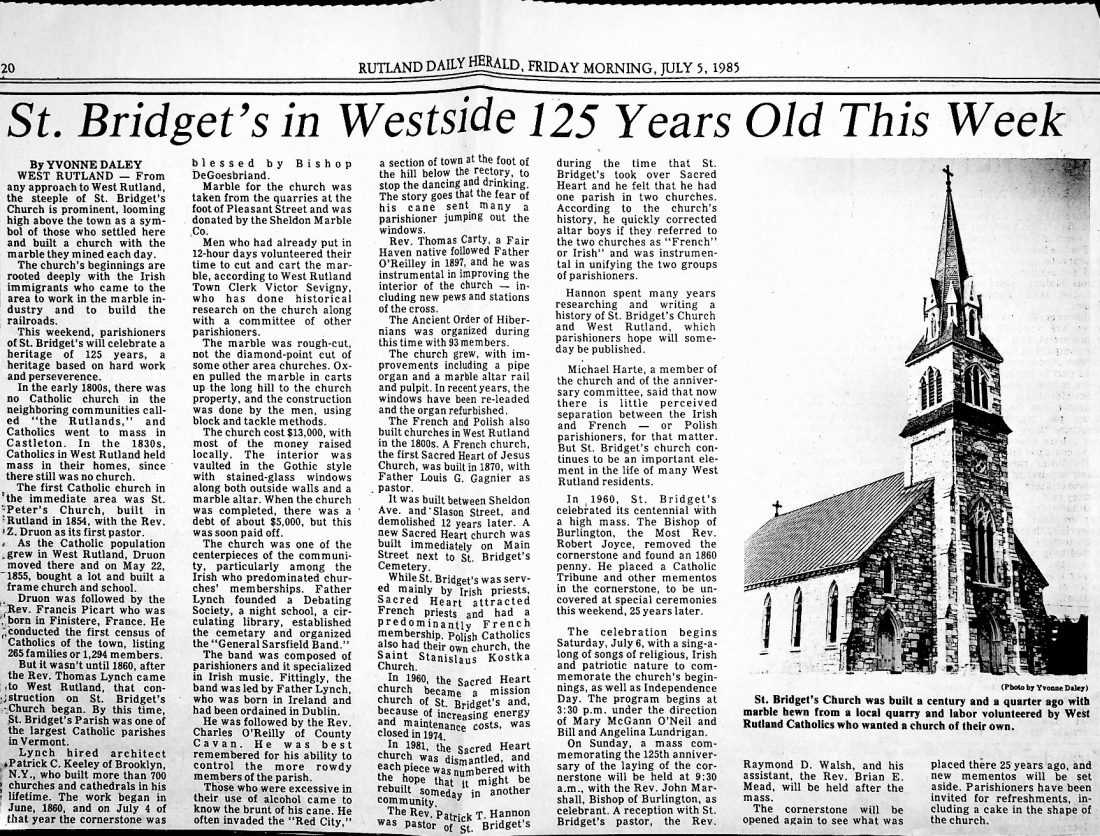
{"page_1": " # St. Bridget's in Westside 125 Years Old This Week\n\nBy YVONNE DALEY\n\n**WEST RUTLAND** — From any approach to West Rutland, the steeple of St. Bridget's Church is prominent, looming high above the town as a symbol of those who settled here and built a church with the marble they mined each day.\n\nThe church's beginnings are rooted deeply with the Irish immigrants who came to the area to work in the marble industry and to build the railroads.\n\nThis weekend, parishioners of St. Bridget's will celebrate a heritage of 125 years, a heritage based on hard work and perseverance.\n\nIn the early 1800s, there was no Catholic church in the neighboring communities called \"the Rutlands,\" and Catholics went to mass in Castleton. In the 1830s, Catholics in West Rutland held mass in their homes, since there still was no church.\n\nThe first Catholic church in the immediate area was St. Peter's Church, built in Rutland in 1854, with the Rev. Z. Druon as its first pastor.\n\nAs the Catholic population grew in West Rutland, Druon moved there and on May 22, 1855, bought a lot and built a frame church and school.\n\nDruon was followed by the Rev. Francis Picart who was born in Finistere, France. He conducted the first census of Catholics of the town, listing 265 families or 1,294 members.\n\nBut it wasn't until 1860, after the Rev. Thomas Lynch came to West Rutland, that construction on St. Bridget's Church began. By this time, St. Bridget's Parish was one of the largest Catholic parishes in Vermont.\n\nLynch hired architect Patrick C. Keeley of Brooklyn, N.Y., who built more than 700 churches and cathedrals in his lifetime. The work began in June, 1860, and on July 4 of that year the cornerstone was\n\nblessed by Bishop DeGoesbriand.\n\nMarble for the church was taken from the quarries at the foot of Pleasant Street and was donated by the Sheldon Marble Co.\n\nMen who had already put in 12-hour days volunteered their time to cut and cart the marble, according to West Rutland Town Clerk Victor Sevigny, who has done historical research on the church along with a committee of other parishioners.\n\nThe marble was rough-cut, not the diamond-point cut of some other area churches. Oxen pulled the marble in carts up the long hill to the church property, and the construction was done by the men, using block and tackle methods.\n\nThe church cost \\$13,000, with most of the money raised locally. The interior was vaulted in the Gothic style with stained-glass windows along both outside walls and a marble altar. When the church was completed, there was a debt of about \\$5,000, but this was soon paid off.\n\nThe church was one of the centerpieces of the community, particularly among the Irish who predominated churches' memberships. Father Lynch founded a Debating Society, a night school, a circulating library, established the cemetery and organized the \"General Sarsfield Band.\"\n\nThe band was composed of parishioners and it specialized in Irish music. Fittingly, the band was led by Father Lynch, who was born in Ireland and had been ordained in Dublin.\n\nHe was followed by the Rev. Charles O'Reilly of County Cavan. He was best remembered for his ability to control the more rowdy members of the parish.\n\nThose who were excessive in their use of alcohol came to know the brunt of his cane. He often invaded the \"Red City,\"\n\na section of town at the foot of the hill below the rectory, to stop the dancing and drinking. The story goes that the fear of his cane sent many a parishioner jumping out the windows.\n\nRev. Thomas Carty, a Fair Haven native followed Father O'Reilly in 1897, and he was instrumental in improving the interior of the church — including new pews and stations of the cross.\n\nThe Ancient Order of Hibernians was organized during this time with 93 members.\n\nThe church grew, with improvements including a pipe organ and a marble altar rail and pulpit. In recent years, the windows have been re-leaded and the organ refurbished.\n\nThe French and Polish also built churches in West Rutland in the 1800s. A French church, the first Sacred Heart of Jesus Church, was built in 1870, with Father Louis G. Gagnier as pastor.\n\nIt was built between Sheldon Ave. and Slason Street, and demolished 12 years later. A new Sacred Heart church was built immediately on Main Street next to St. Bridget's Cemetery.\n\nWhile St. Bridget's was served mainly by Irish priests, Sacred Heart attracted French priests and had a predominantly French membership. Polish Catholics also had their own church, the Saint Stanislaus Kostka Church.\n\nIn 1960, the Sacred Heart church became a mission church of St. Bridget's and, because of increasing energy and maintenance costs, was closed in 1974.\n\nIn 1981, the Sacred Heart church was dismantled, and each piece was numbered with the hope that it might be rebuilt someday in another community.\n\nThe Rev. Patrick T. Hannon was pastor of St. Bridget's\n\nduring the time that St. Bridget's took over Sacred Heart and he felt that he had one parish in two churches. According to the church's history, he quickly corrected altar boys if they referred to the two churches as \"French\" or \"Irish\" and was instrumental in unifying the two groups of parishioners.\n\nHannon spent many years researching and writing a history of St. Bridget's Church and West Rutland, which parishioners hope will some-day be published.\n\nMichael Harte, a member of the church and of the anniversary committee, said that now there is little perceived separation between the Irish and French — or Polish parishioners, for that matter. But St. Bridget's church continues to be an important element in the life of many West Rutland residents.\n\nIn 1960, St. Bridget's celebrated its centennial with a high mass. The Bishop of Burlington, the Most Rev. Robert Joyce, removed the cornerstone and found an 1860 penny. He placed a Catholic Tribune and other mementos in the cornerstone, to be uncovered at special ceremonies this weekend, 25 years later.\n\nThe celebration begins Saturday, July 6, with a sing-along of songs of religious, Irish and patriotic nature to commemorate the church's beginnings, as well as Independence Day. The program begins at 3:30 p.m. under the direction of Mary McGann O'Neil and Bill and Angelina Lundrigan.\n\nOn Sunday, a mass commemorating the 125th anniversary of the laying of the cornerstone will be held at 9:30 a.m., with the Rev. John Marshall, Bishop of Burlington, as celebrant. A reception with St. Bridget's pastor, the Rev.\n\n\n\n(Photo by Yvonne Daley)\n\n**St. Bridget's Church was built a century and a quarter ago with marble hewn from a local quarry and labor volunteered by West Rutland Catholics who wanted a church of their own.**\n\nRaymond D. Walsh, and his assistant, the Rev. Brian E. Mead, will be held after the mass.\n\nThe cornerstone will be opened again to see what was\n\nplaced there 25 years ago, and new mementos will be set aside. Parishioners have been invited for refreshments, including a cake in the shape of the church. "}
Created At
2026-08-28 11:31:11
Tag Category + Tag
people-benedict-arnold
Tag Categories
people
Tags
benedict-arnold
Tag Texts
People: Benedict Arnold
Your library on the go!
ebooks & audiobooks through Libby & The Palace Project
online magazines through Libby
streaming video through Kanopy & Biblio+
streaming music through Freegal